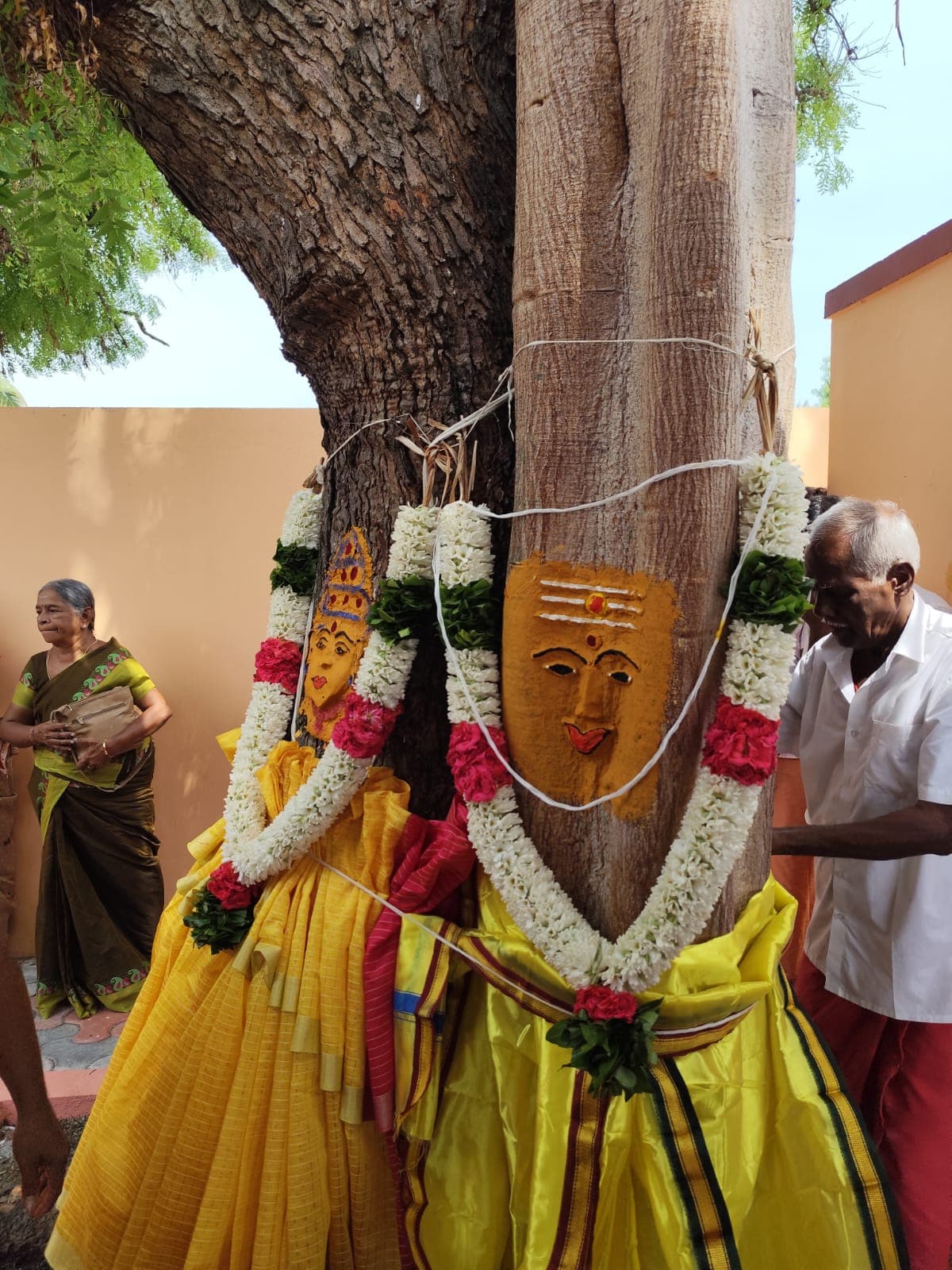
I attended a wedding between 2 trees
I just ended my field days at the ACCC, and had come back home.
I got to know via sources that a small temple nearby was conducting a marriage. And it was between 2 trees! I usually scoff at going to crowded weddings but this one definitely piqued my interest.
Temple and its People
The temple is called “Paataiyyan Koyil” (transl. Ancestor Temple). It is a very small temple, there is no gopuram, just a small Karuvarai that houses the statue of the ancestral couple who are worshipped there, and another room to the south western side of it that houses Ganesha. Around 300-400 years old according to the people there.
It is said that the temple is located at the place where the Ancestor’s body was cremated, and his wife had performed Sati there (as was custom at the time)
The worshippers of this temple belong to the Adi Kootam, a part of the Kongu Vellalar Caste, that consider the deities here as their direct ancestor. The dominant profession amongst the members present here was agriculture, with most holding around 2-3 acres. However, the younger generation also mostly own some small businesses reflecting the region’s economy as a textile and a manufacturing hub.
The Wedding
There was a 20-foot tall 80-ish years old Neem Tree in the premises of the temple. There was also a equally tall 5 year old Peepal tree growing alongside it.
The Peepal was the groom
The Neem was the Bride.
The marriage is supposed to be performed wherever a Peepal grows besides a Neem, and after the Peepal has first flowered.
Asking the person who was heading the proceedings there(Murugesh), he informed us that the Neem is seen as Parvati and the Peepal(Arasan in Tamil, which translates to King) is seen as Shiva.
Why is the Neem the female and the Peepal the male?
What follows is partly based on conversations with him, and partly my own speculation. While the rituals and explanations currently attached to the ceremony are Brahmanical, the practice itself may predate them perhaps emerging from when human life was still connected with nature, before the advent of metal tools altered those relationships.
The Neem is associated with Parvati because it is seen as a protector against disease. Its intensely bitter properties have long given it medicinal significance, and Neem leaves are still commonly placed in Hindu homes. In this sense, the tree comes to embody the archetypal role of the woman-as-caregiver.
The Peepal is associated with Shiva and masculine fertility. Perhaps this may have something to with its rapid growth, or maybe from its tendency to often grow as an epiphyte.
There was a Nichiyam(engagement) ceremony on 12th may evening, where 2 elderly couples were chosen to represent the groom’s family and the bride’s family, and they promise that the wedding will happen following customs.

The next day, the priests paint faces on the tree trunk with turmeric and decorate the couple with flowers and garlands.

Then the Thaali (Wedding Thread) is tied and then everyone blesses the couple by offering flowers and money at the feet of the couple and go around them praying for what they want.
