Interning @ ATREE ACCC - 2/?
Here comes the second and what I thought, initially but perhaps quite falsely, to be the final part of my internship at the Agasthyamalai Community Conservation Center.
Well, the visits for the Green School program continued, and I had to step in and deliver part of the lecture. Since, I had already listened to it multiple times, I could do it fairly well. It was interesting to note that the Government School students again knew most of the names of the herbs, except one, which apparently did not grow near the coast.
We also visited a Temple site to check where the 10th Namma Ooru Nandavanam project can be done.
school program
What followed were a couple of boring days at the Office, where I worked on the Nandavanam Website Design and Development. It was during this phase that I got over my initial star-struckness and began to think critically about the activities that happen at ACCC. Much I do not think I can share here, but I will share a few, that have already been acknowledged and talked about in limited public spaces already.


I also went to assist on a CAMP WILD program for schoolchildren where they went on a nature walk, learnt about macro-invertebrates by actually collecting them (included Apple Snails, other smaller snails, water scorpions, Rove Beetles, Backswimmers,Dragonfly Larvae, Frogs), and also swam in the Tamiraparani River at Mukkudal. They were also given Nature Journals where there were questions that attempted to guide them about what they can question or look for.
The animals were later released.

The vast green paddy fields have started turning yellow already and the crops have started bending under the weight of the paddy! I thought that they would be much much taller, but they do not even reach knee height apparently!
pastoralists
Fast forward a couple of days at the office and some trips to the nearby temples and lakes.

I had the opportunity to go with M Mathivanan to slightly peek into the lives of pastoralists living in the Black Soil Lands of Thoothukudi. Kilometers of nothing but Black Soil, where grasses can’t grow, just a few Neem and Tamarind Trees scattered and you can see the heat distortion near the soil if you look really far. The cattle’s only source of water is some 1 foot of water over a really small area at the centre of the villages. The pastoralists are a dwindling group of people. The pastoralists we interviewed mostly came back every night to their own villages. But I heard one where the shepherd has to go 100s of kilometers and can only go back to his home a couple of times a year.

One intriguing thing here is despite the number of colleges, a Bachelors’ degree is not considered worthy if you want to work in that field, because there just aren’t that many degree-specific jobs and also not all colleges’ Bachelors’ degrees are equal, as I saw here.
Also, Sloth Bears, Snakes and Wild boars are regulars to the surroundings of the ACCC. And we saw plenty of those, sometimes live, or live-streamed or recorded on the CCTVs.
kanthari walks
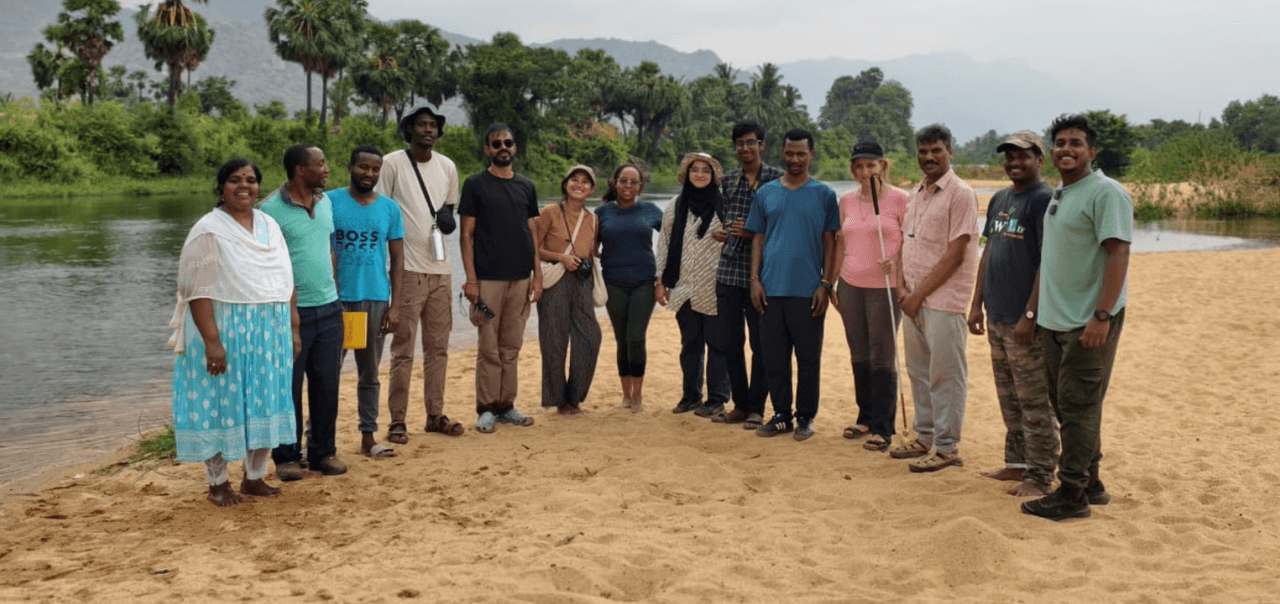
And this brings me to one of the moments that I will never forget in my life. When I took my gap year, I had decided that I wanted to volunteer at kanthari. By some Crazy Good Divine Fortune, they were coming to ACCC(On my birthday of all days!). My chance to get to observe and interact with the kanthari changemakers and their co-founder Sabriye Tenberken, whose small part of journey I have read about on her book My Path Leads to Tibet.
The team that was going to accompany sat on the previous night, past office times, and studied in detail about all of them, who are they? what are they working on? what would they be interested in? and so much care was being taken that this experience would be aligned with their own journeys. This, I believe, should be a standard to all teachers everywhere. Someone who understands the impact of what they are putting out into the world, and gives it their all.
There were multiple separate incidents that were quite intriguing, but in keeping with the values of this blog, (SEE first post) I shall name one here, the rest, will go to my private diary until the time I actually make something of it, which will take a longgg time.

There was a small 10 minute interaction between the students of Is_a Home School and the kanthari team, which was quite revealing, despite it’s short nature.
The kanthari team had questions,” Was this an alternate school”, “How is the school”, “Was the school inclusive”, “What did you learn about?”, “Did you meet the tribals”, and, also wanted to know what students were taught about the caste system.
The school first talked about their plus points, “Holistic education”, “No exams till 8th grade”, “1:4 Teacher: Student Ratio” but they all pay fees to study here. But the organization also had another setup of school to cater to rural children who cannot afford this level of education, where the teacher: student ratios were not impressive, where the education given was different.
Their teacher, stepped in when the question was about caste, he proudly proclaimed something along the lines of “do not come by reading about caste from your books and relating with what you know, you have to experience it to understand, that caste is no longer a problem, none of our students know the other students’ caste”.
(I have mentioned before and I shall mention here again, the views I mention are purely my opinions, this is my blog after all yea?)
What’s interesting here is the contrast: the kanthari team is made of people who have overcome incredible adversity to make change. and on the other side, students who, when they grow up, will will easily be ‘put’ in chairs of influence, who haven’t faced a day of adversity in their own lives, and the realities of hardships not taught.
My further reflections on this, for the moment, shall remain private.
Reflections
The next part of this was the Centre being put in a position to reflect on and answer for its’ activities over multiple years. The discussions for this too, are private. What I choose to reveal in this blog is what is already publicly known.
- Despite or because of government’s efforts, (i am not really sure which), there are huge obstacles for ecological research funding, especially for long-term projects, many of which have to be cut if they haven’t yielded results in a substantial level. The government, and majority of funders are interested in research that can be used to inform policy and impact livelihoods. So studies that do not have a people-oriented research question or output (or some visible scope for one), will unfortunately be cut because this is not a ideal world.
- communications and policy thinktanks are only involved after the complete research is concluded, leaving them to play puzzle with scattered finished pieces, not knowing whether they fit together. The people who are doing the research work in silos, closed off from what Policy pushes are happening based on their work, and what policymakers are looking for. A ship-and deliver (one-way) model instead of a continuous two-way involvement model. This has also been discussed in larger public spaces.
Cover Photo by Vinod Kumar
(acknowledgements and references will be uploaded soon)